|
Valuing the outside sales effort: Portent for change, Part II
The second part of our exclusive research on the changes demanded by customers regarding the outside sales effort.
by and
Do customers recognize the value of distributor salespeople? Are distributors making the best use of one of their most expensive resources, the outside salesperson? Those are some of the questions that begged for answers after seeing the results of a survey Progressive Distributor conducted last year in which nearly half of OEM/MRO buyers said they do not want distributor salespeople calling on them.
To dig deeper into customer attitudes about distributors, Progressive Distributor recently conducted an exclusive research project with Chicago-based Benfield Consulting.
As reported last issue, the 12-question survey used a comparative value format to gauge the importance of outside sellers compared to other services generated by distributor suppliers. Respondents gave one of four answers to questions ranging from 1=Disagree, 2=Somewhat disagree, 3=Somewhat agree, and 4=Agree.
We faxed the survey to buyers of industrial MRO, OEM, electrical, HVAC and PVF products with job functions of purchasing, production, maintenance or capital projects.
Approximately 65 percent of the respondents were in purchasing and 35 percent were in the user/buyer groups of production, maintenance or capital projects. There were no statistical differences in the responses from people in purchasing or the user/buyer groups except for two questions (numbers 4 and 11), and the vast majority of respondents purchased or used all represented product groups. Finally, the size of the firms represented ran the gamut from local manufacturing firms to Fortune 500 conglomerates. So, let’s visit the next round of questions, scores and interpretations.
Question 7: “My suppliers could create new
and different services that would be of value to me.”
The score for this question was 3.2, the second-highest scoring question. Clearly, manufacturer buyers are interested in new services that demonstrate value. We did not ask what these services might be and how (or if) they can be priced. The strong response, however, is a solid indicator of potential in this area. Recent work in development of fee-based services by Benfield Consulting has found that fewer than 10 percent of industrial distributors pursue fee-based services as a current growth strategy. Industrial distributors may want to rethink their position on creating fee-based services.
Question 8: “My suppliers offer managed
inventory services, but I am not interested in them.”
The score for this question was in the middle of the pack at 2.4. In essence, more people agreed than disagreed with the question.
Our take on the meaning is fairly straightforward. Many industrial distributors offer managed inventory services. These services vary in scope and scale and often involve collaborative services with a variety of distributors. Whether the call is for integrated supply, vendor-managed inventories or bin-stocking programs, most industrial customers know about the services and, at least, have an idea of the services offered. There is little new and exciting in these services. They are available if needed and are probably entering their mature phase. There are still a sizable amount of customers interested in these services, but our guess is that the bloom may be fading from the rose. It may be difficult for the average industrial distributor to find new, exciting and above-average profits in offering these services. They are simply too common.
Question 9: “My suppliers could offer
more ways of ordering than by fax or phone.”
The average score of this question was 2.9, the fifth-highest score from the survey. The obvious substitute for the fax or phone is e-commerce. The surveyors stayed away from the “e” word just to see what the respondents would do. Several respondents wrote “e-commerce” in the margins of the questionnaire. Despite all of the hoopla and broken dot-com models, buyers still seem willing to try e-commerce. The questions that few seem willing to answer or experiment with are these: Will buyers require a price decrease for orders that are sales unassisted? In essence, if the buyer performs the order-entry function, will they demand compensation from the supplier for the extra work they perform internally? Or, can distributors develop e-commerce capabilities and convince current customers to use them without an incentive?
Question 10: “My suppliers provide creative ways of saving time and money by improving supply chain efficiencies."
The average score for this question was 2.4. Like question No. 8, this question refers to managed inventory services as well as any other demonstrable method of improving the supply chain. Since the question is in the middle of the survey range, it is hard to pinpoint any new or profound insight into supply chain offerings. Quite simply, some customers believe suppliers are doing a good job in this area and some don’t.
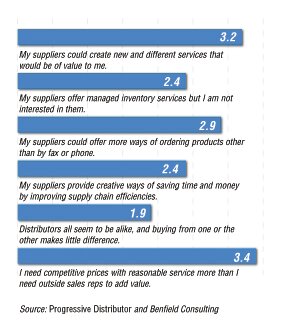
Question 11: “Distributors all seem to be alike, and
buying from one or the other makes little difference.”
Finally, here is a question that is not in the middle of the scale, with an average score of 1.9. This was the only question where there were more who disagreed than agreed. In essence, a little over half of the customer base believes that distributors can and do differentiate their offerings. Interestingly enough, almost half of the customers seem to believe that there is a reasonable difference in “…buying from one (distributor) or the other…” How distributors translate this difference and capture the value is the $64,000 question. For the faithful, a significant part of the customer base still perceives a difference in distributor offerings.
On a cautionary note, however, a fairly significant number of respondents (30 percent) either somewhat agreed or agreed with the statement. We believe this signals a significant group of economic buyers in industrial markets. Consequently, there is likely room for a stripped-down, low-cost model of distribution. Do we have any volunteers?
Question 12: “I need competitive prices with reasonable service more than I need outside sales reps to add value.”
Yes, we saved the highest-scoring question (average score of 3.4) until last. In short, most buyers agree or somewhat agree with the statement. Roughly three-quarters of the respondents gave the question a 3 or 4.
Our take on this question is obvious. When you attend any distribution industry convention, you’ll find that the majority of training is about adding value through the outside sales force. While distributors and others are hip on the subject of value-added selling, buyers clearly value competitive pricing and reasonable service. If you factor in the results from the other questions on services, the value of inside sellers, the need for catalogs, flexible sales calls, etc., the score for this question should be no surprise. Are distributors stuck in a model of adding sales value when customers value other services more or simply want to see outside salespeople less?
Clearly, distributors still need outside salespeople. But distributors need to ask themselves some key questions in the near future. For example, exactly what role should outside salespeople play and for which customers? Where should you allocate the traditional sales model? Are there opportunities for other distribution models that don’t use salespeople (other than catalog houses)?
Simply plopping salespeople into geographic territories or hyping them up with managed inventory skills may not continue to win kudos from the customer. Some percentage of your customer base will continue to appreciate the value-added benefits that outside salespeople bring. But our survey findings show that there is a growing number of economic buyers who don’t value — and don’t want to pay for — the services of your outside salespeople.
Salespeople with advanced technical, process or industry skills are consultants. They should be paid for their consulting advice and not allow it to be lumped in with the price of the product. Otherwise, their efforts amount to consulting for the competition.
Finally, we know that this survey is only a beginning. Much more research and investigation needs to be done. Of course, in a sales-driven business, the results are not always popular. As responsible marketers whose livelihoods are made in serving distributors, their vendors and customers, however, we feel the need to challenge the status quo, grapple with the tough questions, and discover new areas of value or models of business for which the customer is more willing to pay.
 Scott Benfield is a consultant for distribution. He can be reached at . Scott Benfield is a consultant for distribution. He can be reached at .
 Richard Vurva is editor of Progressive Distributor magazine. He can be reached at . Richard Vurva is editor of Progressive Distributor magazine. He can be reached at .
This article originally appeared in the March/April '02 issue of Progressive Distributor. Copyright 2002.
back to top back to selling skills archives
|