|
E-commerce: It's not about technology
by F. Barry Lawrence and Brian E. Reynolds
Like most distributors, you've heard it all. Consultants and information technology (IT) companies tell you that e-business will redefine the supply chain and you'll be eliminated if you don't buy their services. They explain how the new supply chain will be filled with electronic gizmos and communication that you don't understand, but they'll take care of it for you.
This argument hinges on technology being the central issue in e-business. If you believe that, prepare to be one of the many companies (nearly all) that have been shocked by the cost of e-commerce and disappointed in the finished or semi-finished product. Many firms turned over their e-business component to consultants or IT firms to design a strategy and set up the technology; others tried to do it themselves with assistance on specific technologies only.
Both strategies had the same result. Once the company begins implementation, it requires additional technology (cost goes up), training needs skyrocket (cost goes up) and processes stop working because the technology solution is a poor fit with the way you do business (costs explode). The next step is to pull the plug after losing hundreds of thousands (or millions) of dollars and try to figure out how to stop the bleeding.
What's the problem?
A computer is like a 4-year-old that adds at the speed of light. It is very powerful, but you must explain everything in excruciating detail or it will not understand. The process also must operate in the same fashion every single time or the system won't know what is going on.
Do your processes always do the same thing? Can you detail them in simplistic (programmable) terms? Will your people follow procedures exactly as designed? Unless you answer yes to all these questions, look out.
Consider a simple example, enterprise resource planning (ERP) systems. ERP promised to be the great solution to communication and decision-making within the firm. Accounting, finance, operations, sales, etc., would operate from the same information in real time, breaking down the walls between departments.
The name of the game is data integrity. The system must know exactly what is on the shelf, what was pulled, counted, moved, altered, etc. If not, the system is garbage. Sure, the payroll module still works, but disaster may strike elsewhere.
For example, in an ERP system, cycle counting is essential to system maintenance. In a typical cycle count, a picker goes to the primary location defined by the ERP system and counts what is on the shelf. If the count is incorrect, the picker must check secondary locations and count them as well. If it is still incorrect, the picker must check loading docks, trucks and value-add areas. If you invoice at the end of the day, the picker must check for in-transit items. All of this must be done for every item counted.
Who winds through this complex mystery of finding the missing merchandise? Probably the lowest-paid, least-trained individual. What if the count is still incorrect (as is so often the case)? Do you update the system or wait and count again? Most choose to update, and the items with correct counts now have incorrect ones. In other words, the system has absolutely no idea what is going on within that firm.
Many ERP system implementations were made because of Y2K, not because the distributor thoroughly planned its operations and was ready for complete information automation. When you automate a broken process, you do stupid things really fast. Employees lose confidence in the system and start operating off-line.
In other words, they are worse off than they were before implementing the new technology. Performance drops after spending all that money on the new system. Most ERP systems look like a train wreck in slow motion and their owners don't even know why.
What does this have to do with e-business?
Many distributors do not have ERP systems and have no intention of getting one. What they have is a back-office system comprised of whatever computer systems run the business. It may be a warehouse management system (WMS) coupled with a simplified ERP system, or it may simply be a group of spreadsheets to track sales and accounting data.
Lately, however, software companies called application service providers (ASP) started offering modules that reside in ERP systems over the Internet in a "pay as you go" mode. This allows firms to build their own ERP system. The challenge for ERP providers is to drive system costs down and prove one system is better than a connected series.
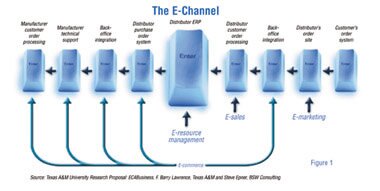
What will happen to ERP remains to be seen. At this point, however, it's useful to understand the e-channel components in order to design an e-strategy (see Figure 1).
The channel at work
In Figure 1, the e-channel is represented by the backward flow of information that controls the forward flow of material in the traditional distribution channels. Information gathered at each step should improve the forward flow of materials. In other words, we are trading information for inventory.
The process begins when the customer places an order. In the e-business world, a Web site transfers the sale to the ERP or e-resource management system (the distributor's back-office system). With information-automated customers, the order is entirely electronic. Most likely, however, there is a mix of traditional methods and new technology.
Some customers phone or fax orders that are captured by inside
sales and entered into the system. Sometimes, a customer transmits an order via EDI, but the order is manually keyed into the distributor's host system (some distributors jokingly call this a "sneaker net"). Although transparent to the customer, the system is nonetheless costly, inefficient and a poor use of technology.
The e-marketing portion of the channel is the electronic billboard that makes your presence on the Web known. This includes your catalog and advertising. Much attention has been paid to this relatively small issue in the past year. Market makers (who we will discuss later) try to play this role as well as the role of e-sales.
E-sales represents the order-processing function. Before distributors can process an order, however, the system has to understand it. If a customer describes an item in terms the customer understands, the system must convert it to its own language (part numbers, SKUs, etc.). This translation function is called back-office integration.
Back-office integration occurs in every firm regardless of the level of technology. The inside sales person takes the order and translates it before entering it into the system.
E-business back-office integration automates the process so the system makes the translation automatically. This requires a sophisticated system with complete and accurate information (data integrity issues). Back-office integration is a business-to-business efficiency process (as opposed to sales and marketing) and is, therefore, defined as e-commerce.
E-resource management is the ERP (or whatever form) the back-office system may take. It connects back to the manufacturer through the same types of instruments used on the
front end.
Remember, the ERP system is just one part of the e-business channel and isn't yet under control. E-business problems are many orders of magnitude larger than ERP issues and will follow the same path unless you think of the system as a whole and attack it strategically.
So, how do you approach e-business?
Put first things first.
1) Stop being afraid. The Net market makers and IT companies feed on fear. They confuse you with techno-babble, paralyze you with fear and then move in for the kill. They promise systems they have not developed, functions they don't understand, solutions they can't implement and results they can't produce. They wreak havoc with your organization and then they're gone. When the system crashes, you pay through the nose for training and for them to fix problems they created. The process can be never-ending.
2) Hesitate. Remember DOS? If you went to the trouble of studying how to use DOS, you wasted your time. Windows took over. How many times have you bought a new computer or software package only to see a new, improved, easier-to-use version six months later? That is the nature of IT systems. Don't be the beta test unless you are being compensated for it. To be certain, this is a short-term strategy (there is a limit to how long you can hold back). Remember, hesitate, but don't stop.
3) Recognize the true issue. Market makers (dot-com companies) and IT providers claim great savings will come your way if you use their services (and pay fees or hardware/software costs). They typically promise savings in transactions costs, forecasting, etc. What they really promise is to make you more efficient at things you understand better than they do.
These things can only be done if you can document your processes for them. If you can document what you do, you may not need them. The true issue is that distribution processes that are not consistent and documented (programmable) are not efficient.
Their promises are only good because your processes are inefficient. The rub is that for them to succeed, you must make your processes efficient first.
4) Get busy on the true issue. Start understanding, documenting
and redesigning your business processes to prepare for e-business. Once the software becomes more affordable and fully adaptable (a few years seems likely), distributors that are prepared will clobber the competition. Forget about manufacturers going direct. If that were the best channel, it would have happened long ago (e-business really doesn't change the manufacturer/distributor relationship).
5) Train, train and then train some more. The information-based organization must never stop learning in order to succeed. Your people must understand how processes are supposed to be carried out and why they are done that way. Discipline is not something you get from a computer system. It must exist before the system, or the system will fail. The successful utilization of technology will cause a major shift in company culture. Consistent, appropriate training and effective communication will increase the probability of success.
6) Spend money on the right things and become an intelligent consumer. One way to ensure that you spend your money wisely is to understand your own processes. If you have documented them with your people and continually asked why they operate as they do and how they should operate, then you will know what IT systems must do to be effective. This is also an excellent opportunity to identify and remove redundancies, unnecessary complexities and any other non-value-add activities.
It's your game to win
So, blow away the confusion and get busy preparing your operations for the information revolution we all know is coming. Distributors are information-based companies controlling customer information, technical information and sourcing information. The bottom line is that customers used to pay for inventory management and information. Information will start replacing inventory, so you will become increasingly dependent on information for your income.
Your organization must be a learning organization that capitalizes on that information. Do not believe consultants and IT providers can do it for you. It would take you longer to teach them distribution than it will take them to teach you their technology.
What's important is the information that unfolds in every aspect of the supply chain every second of every day. The distributor has access to all of that information, from customer demand, to transportation, to distribution processes, to sourcing possibilities and capabilities. No one else has that kind of information power. The game is the distributor's to lose.
F. Barry Lawrence is an assistant professor in the industrial distribution program at Texas A&M University and Brian Reynolds is associate director of the Thomas A. Read Center for Industrial Distribution Research and Education.
This article originally appeared in the November/December 2000 issue of Progressive Distributor. Copyright 2000.
back to top back to e-business archives
|