|
 When the lights go out When the lights go out
ASTM-Standards compliant Photoluminescent safety markings help you find your way.
Just imagine a full blackout in your facilities. A sudden power failure, perhaps caused by a tornado, an earthquake or other natural disaster! Or think of a fire with thick smoke quickly spreading through your building. Following the World Trade Center bombing New York in 1993, many building occupants had to escape through darkened, smoke-filled staircases with the code-required emergency lighting broken down. Even in your familiar surroundings, you can easily feel trapped in the dark, and panic is likely to strike.
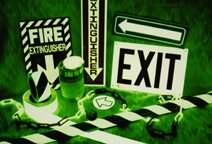
These are typical situations where photoluminescent safety markings come to your rescue as non-electrical emergency lighting. The markings absorb daylight or artificial light and emit a yellowish luminance in full darkness.
You may be well familiar with ‘glow in the dark’ Halloween items or toys for kids. The daytime color of these gimmicks is similar to ‘photoluminescent safety markings’, whereas the darkness performance is severely lower. Up to now, in numerous cases buyers were simply judging the daytime color and accidentally bought cheap toy-type glow products for use in safety applications. Price was the decision-making factor. In an actual emergency, such ‘glow in the dark’ low-glow products would not perform as needed and would not provide the necessary brightness to illuminate your escape route.
Due to a lack of standards, it has been extremely difficult to judge whether true photoluminescent safety products or ‘glow in the dark’ gimmick materials were installed as escape route markings. This recently changed, when the American Society for Testing and Materials, ASTM, published two new standards to aid buyers:
• E 2072-00 - Standard specification for photoluminescent (phosphorescent) markings
• E 2073-00 - Standard test method for photopic luminance of photoluminescent (phosphorescent) markings
Specification E 2072-00 requires a laboratory-tested photoluminescent safety marking to emit at least 20 milli candela per square meter after ten minutes in the dark, and 2.8 mcd/m² after 60 minutes in the dark. On site, a 100-mm [4”] wide safety marking has to emit minimum 15 mcd/m² ten minutes after activation has ceased, and 2.2 mcd/m² after 60 minutes. This is identical with international standards, such as German DIN 67510 and IMO Resolution A.752(18).
In the ASTM specification, markings that do not fulfill these minimum luminance requirements are non-suitable for safety applications. Their use should be limited to Halloween, gimmick and toy use.
Test Method E 2073-00 clearly outlines how to properly test the luminance and record the findings in a report. A luminance certificate is written, which guarantees buyers that they purchase a standard-compliant safety marking.
Additionally, E 2030-99 Guide for Recommended Uses of Photoluminescent Safety Markings, describes installation possibilities and provides drawings to highlight typical applications in corridors, staircases and as signage (including escape route plans and ADA-compliant signs).
 "These new standards will avoid any future confusion among manufacturers, architects, code officials and the ultimate users regarding sufficient luminance intensity and duration, proper installation and suitability for safety purposes," said Marina Batzke, general manager of American PERMALIGHT Inc., out of Torrance, Calif. She initiated the standard-writing activity in 1995 and has since been chairperson of ASTM sub-committee E 12.13. ASTM sub-committee E 12.13 consists of code-writing organizations, users, producers, and members with general interest in the topic ‘photoluminescent safety markings’. "These new standards will avoid any future confusion among manufacturers, architects, code officials and the ultimate users regarding sufficient luminance intensity and duration, proper installation and suitability for safety purposes," said Marina Batzke, general manager of American PERMALIGHT Inc., out of Torrance, Calif. She initiated the standard-writing activity in 1995 and has since been chairperson of ASTM sub-committee E 12.13. ASTM sub-committee E 12.13 consists of code-writing organizations, users, producers, and members with general interest in the topic ‘photoluminescent safety markings’.
“These documents allow a clear distinction between ‘Photoluminescent Safety Markings’ and ‘glow in the dark’ gimmick qualities.” "These documents allow a clear distinction between photoluminescent safety markings and glow in the dark gimmick qualities," said Batzke.
From now on, when you purchase photoluminescent safety markings – may it be just one sign or a full escape route system to improve darkness safety in your facilities – ask your supply source for products in compliance with ASTM E 2072-00 and
E 2073-00," said Batzke. Your supplier should have luminance certificates that cite these standards and list the luminance values measured which have to meet or exceed the luminance requirements mentioned earlier."
A standard-compliant photoluminescent escape route system will help you find your way out of your building during a darkness-related emergency. You improve the safety of all your building occupants. Photoluminescent safety markings help to avoid panic and help to save lives. That is the most important benefit.
ASTM standards are available by calling customer service at , or through the Web site www.astm.org. For meeting or membership details, contact manager Bode Hennegan, ASTM ; email: .
To learn more about the work of Sub-Committee E 12.13, contact Marina Batzke, American PERMALIGHT Inc at. ; fax ; email: .
Back to Web Exclusives contents
Back to MRO Today front page
|