|
 Automaker estimates $850,000 Automaker estimates $850,000
savings from rooftop cable coating
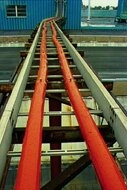
A major midwestern auto manufacturer estimates that it has saved a total of $850,000 through the innovative use of a silicone sealant to re-coat failing PVC-jacketed electrical cable, preventing the need to replace approximately 15,000 linear feet of the company's medium-voltage wiring. The savings were achieved when a local painting contractor sealed the facility's entire rooftop cable system with Dow Corning 700 Industrial Grade Silicone Sealant.
The silicone caulking material was used to coat directly over the dry, cracking PVC cable jacketing. The result was renewed cable life and protection that is expected to last 20 years or more, at a fraction of the cost to replace the old cable.
"During a routine inspection in 1998, facility engineers noticed that the building's PVC-coated cable had faded and cracked from UV exposure and weathering," said Jim Stutelberg, Dow Corning Market Manager for Industrial Assembly & Maintenance. "In fact, lengthy sections showed signs of possible water intrusion, which indicated that some action would have to be taken quickly," he noted. "At the time, engineers felt the only certain remedy would be replacement, a project that would have meant significant expense, plant downtime and lost production."
At the suggestion of a Dow Corning representative, however, the company investigated an alternative: a durable silicone sealant that could be used to restore the integrity of the aging cable. After testing the adhesion and UV protection of the silicone formulation, an industrial painting contractor was hired to recoat 7,200 feet of cable on the plant's roof.
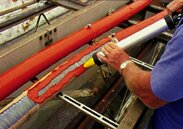 The contractor developed some simple application tools and had little difficulty in applying the material, which was tooled to an average thickness of 1/8 inch to 1/4 inch. The sealant cures at ambient temperatures to a tough, rubbery solid that is virtually unaffected by UV light, ozone, rain and extreme outdoor temperatures. The contractor developed some simple application tools and had little difficulty in applying the material, which was tooled to an average thickness of 1/8 inch to 1/4 inch. The sealant cures at ambient temperatures to a tough, rubbery solid that is virtually unaffected by UV light, ozone, rain and extreme outdoor temperatures.
Upon evaluating the initial phase of the project, the engineers estimated a savings of more than $400,000 from recoating instead of replacement. Based on the customer's 1998 calculations, the savings are illustrated as follows:
Labor to install new cable $34.05 / linear foot
Purchase price of new cable 30.93 / foot
Total installed cost $64.98 / foot
Labor to recoat with silicone sealant $ 5.33 / foot
Purchase price of sealant 3.04 / foot
Total cost to recoat $ 8.37 / foot
Cost to replace 7,200 feet of cable $467,856
Cost to recoat 7,200 feet of cable 60,264
Total cost savings $407,592
The results were so impressive that the manufacturer decided to seal the remaining 7,800 feet of its rooftop cable system, a move that has been estimated to result in a total savings of approximately $850,000.
"Medium voltage rooftop cable is the most common means of distributing electrical power in large industrial facilities," explained Stutelberg. "A PVC coating is normally used over the flex conduit that holds the cable, but UV radiation, rain, ozone and extreme temperatures take their toll over time, eventually leading to water intrusion and potential service disruptions. If the problem is identified soon enough, however, this process is an economic alternative to replacement."
Applied directly over the old PVC coating, the one-part Dow Corning sealant cures on exposure to water vapor in the air. The material forms a tack-free skin within 15 minutes at 77 F (25 C) and 50 percent relative humidity. Under those conditions, sections up to 1/8-inch thick will fully cure in approximately 24 hours. Exact cure time will be affected by humidity, degree of confinement, and application thickness.
The fully cured sealant exhibits good resistance to weathering and extreme temperatures, retaining its elastomeric properties over a temperature range from -76 F to 350 F (-60 C to 177 C) in continuous use, and up to 400 F (204 C) for intermittent use. Unlike most organic sealants and cable coatings, the silicone formulation exhibits excellent resistance to the environmental stresses which break down polymers such as PVC.
Silicone sealants are not significantly affected by UV radiation, ozone, rain, snow or extreme temperatures. They maintain flexibility, allowing them to withstand thermal cycling over their typical outdoor lifespan of more than 20 years.
Dow Corning 700 Sealant is a medium-modulus silicone formulation (specific gravity 1.02) with an extrusion rate of 475 grams/minute through a 1/8-inch orifice at 90 psi. When properly cured, the material forms a 25-duruometer elastomer (Shore A) that delivers a tensile strength of 225 psi, tear strength of 19 ppi and 500 percent elongation.
This versatile sealant is recognized under UL QMFZ2, as well as the National Sanitation Foundation List 51 for direct food contact and FDA Regulation 21 CFR 177.2600 for incidental food contact. It is not intended for medical or underwater applications, and is not recommended for use on Teflon, polyethylene or polypropylene.
Dow Corning develops, manufactures and markets a diverse range of silicon-based materials. Currently offering more than 10,000 products to customers around the world, the company is a global leader in silicon-based technology, with shares equally owned by The Dow Chemical Company and Corning Incorporated. More than half of Dow Corning's sales are outside the United States.
Dow Corning 700 Industrial Grade Silicone Sealant is available in a variety of colors, and is supplied in 3-ounce tubes, 10.3-ounce cartridges, 4.5-gallon pails and 52-gallon drums. All packaging includes a multi-lingual label with information printed in English, French and Spanish.
back to MRO Today Main Page
back to the top back to online exclusives
Copyright 2001 Pfingsten Publishing L.L.C. All rights reserved.
|