|
Selecting brushes
Tips on how to choose the right abrasive brush for the application
by Imre Karetka
The unavoidable and unintentional byproduct of manufacturing practices is the generation of burrs and sharp edges. Besides the safety hazards associated with burrs and sharp edges, their presence adversely affects the functionality and performance of the manufactured component.
Manufacturers resort to a number of methods to remove these unwanted attributes. Deburring practices can be classified into two groups: mechanical and chemical deburring. Common methods to mechanically deburr parts include: sanding, tumbling, sandblasting and brushing. All of these methods have advantages and disadvantages. One of the biggest disadvantages is the cost associated with the purchase of specific equipment. Perhaps the most economical solution to mass deburr manufactured parts using current equipment is the use of power brushes.
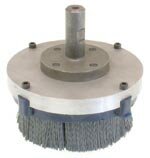
The industrial applications of brushes vary from paint removal and deburring to honing and polishing. These surface-conditioning tools are used on a wide variety of materials including aluminum, steel, carbide, wood and glass. The advantages of brushes include flexibility, durability and repeatable uniform results. The physical designs as well as some of the available adapters (Photos A and B) make these tools readily adaptable to machinery widely used in today’s manufacturing environment.
Although a number of different brush types and configurations are available (Photos C through F), the two major components that make up a brush are the filament type and the mounting hardware.
The mounting hardware introduces the filament to the workpiece. The more important component, responsible for performing the actual deburring, is the filament. Filament types range from artificial to natural. Some naturally occurring filaments used in brushes are tampico, sisal and horsehair. Use of these filaments varies according to the application. Generally, these are not abrasive by themselves, but are used for polishing and cleaning applications in conjunction with some sort of abrasive compound.
The most commonly used filament types are abrasive and crimped wire. Examples of crimped wire filaments are steel, stainless steel, bronze, brass, phosphorous bronze and, in rare cases, gold.
Abrasive filaments vary from silicon carbide to aluminum oxide to polycrystalline diamond. Depending on the grit size, these filaments are used for deburring, polishing, blending and surface-conditioning applications. The filament is a mixture of specially formulated nylon, with varying grit sizes of abrasive crystals homogeneously distributed (Photo G).
In many cases, the filament has additives that aid with heat transfer and moisture absorption. Because the carrier is nylon, heat is a significant limiting factor. The use of coolant with a pH level between 2 and 9 is strongly recommended. If liquid coolant isn’t an option, use forced air to keep the brush cool. The melting point of most nylon filament is 410 degrees F. At 210 F, the abrasive filament loses 70 percent of its stiffness. When beam strength (stiffness) is lost, the brush won’t perform as aggressively and predictably. Use side plates or bridles to counter strength loss.
The crystal structure in conjunction with grit size determines the filament’s aggressiveness. Silicon carbide and polycrystalline diamond crystals are characterized by sharp, jagged edges (Photo H). Aluminum oxide and aluminum silicate have a more rounded crystalline structure (Photo I).
Due to these characteristics, a brush with silicon carbide filament is more aggressive than a brush with aluminum oxide-impregnated filament. The most commonly used abrasive grain sizes vary from 46 grit (coarse) to 1,000 grit (fine). For an aggressive deburring application, use coarse abrasive grain size. Polishing applications call for 1,000-grit grain.
Another consideration is industry segment. Since silicon carbide filament is more jagged, it tends
to break off and embed into the workpiece. Because of this, many fabricators in the aircraft industry insist on using a brush with aluminum oxide filament rather than silicon carbide-impregnated filament.
Wire filament
The most important trait when it comes to crimped wire filament is the wire’s hardness. Generally, carbon steel wire has a hardness of Rockwell C scale (Rc) 55-60. Stainless steel
wire is Rc 30-35. Use brass, bronze and beryllium copper filaments where softer materials need work (rubber, aluminum) and in low sparking applications.
The important characteristic of wire filament is that the deburring takes place only at the tip of the wire. Since the tip is where a sharp edge is found, this is the only part of the wire capable of cutting.
The large majority of brushes sold are crimped wire. Perhaps the most important feature is its ability to break off and expose new cutting points. If the crimped wire is compared to a wave, the breaks generally occur at the crest and trough. These points act as stress risers. Therefore, the initial break takes place at these points and exposes new, sharp cutting points.
A common application problem encountered is overpenetration. If a wire brush is overpenetrated, the filaments act like small hammers on the workpiece surface. The easiest way to determine if a wire brush is overpenetrated is to examine a part after the initial deburring application. If the part’s edge resembles a shot-peened surface, with the sharp edge still remaining, this is correctable by decreasing the brush penetration.
Brush selection
When selecting a brush, the most important questions to answer are:
• What’s being pursued (i.e. deburring, edge break, polishing, cleaning)?
• What’s the workpiece material?
For example, if the goal is to deburr a stainless steel tube that was saw cut, use either an abrasive or stainless steel wire brush. Use a stainless steel brush to reduce contamination on the workpiece. Where a carbon wire brush will probably deburr the part faster, it will also leave traces of carbon steel that cause the part to oxidize.
If the tube is harder than 35 Rc, the only other option is the use of abrasive filament. Depending on the equipment used and its limitations, either a cup or radial brush will work. Usually employ the largest brush that the equipment can handle. The benefits are twofold. Due to the brush’s size, the part can be deburred in one pass as opposed to two or more. The other advantage is that the brush will be changed less frequently, leading to less machine downtime.
Remember safety
As with any task, safety is a paramount concern. Just as cutting tools dull and deteriorate over time, so do brushes. After a number of cycles, the wires fatigue, break and fall out of the brush. At various operating speeds, these loose filaments have enough velocity to puncture clothing and skin. For offhand deburring, use leather gloves, a thick leather apron, a full-face shield and work boots.
Imre Karetka is an application engineer for Osborn International. To learn more, visit www.osborn.com or e-mail .
This article appeared in the December 2004/January 2005 issue of MRO Today magazine. Copyright, 2005.
Back to top
Back to Uptime archives
|